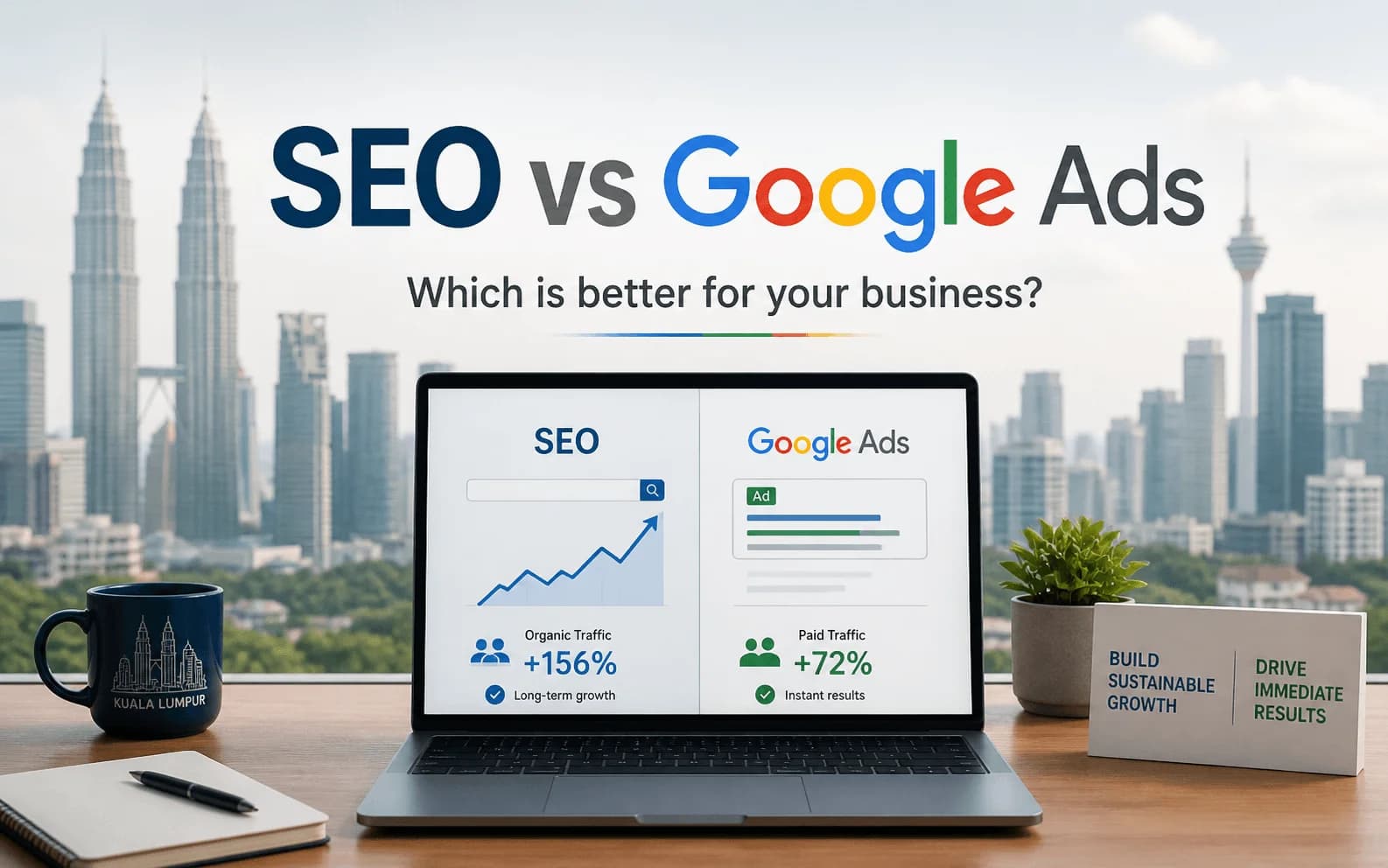
TL;DR: Google Ads buys traffic. SEO earns it.
Google Ads delivers leads in 24–72 hours but stops the moment you stop paying.
SEO takes 6–12 months to deliver but keeps generating traffic for years.
Google Ads CPC averages USD 2.69 (~RM 10.60). SEO costs RM 2,500–7,000/month for an SME campaign.
As in 2026 AI Overviews now occupy 25–50% of search results, which has dropped organic CTR but also pushed Google Ads spend up because advertisers compete for the shrinking blue-link space.
The right answer depends on your timeline, budget, and how patient you are.
Most businesses ask the wrong question.
They ask "SEO or Google Ads?" as if it's a fight, with one winner.
It's not a fight. They're different digital marketing strategies with different results.
Google Ads is a tap.
Turn it on, and water flows. Turn it off, water stops. Predictable, controllable, expensive.
SEO is a well.
Takes months to dig. Once it's flowing, it keeps flowing for years. Cheaper per litre, but you can't drink for the first six months while you're digging it.
This article breaks down what each one does in 2026, what each costs, and how to pick the right one for your business — or how to combine both when budget allows.
What Is SEO?
SEO (Search Engine Optimisation) is the work you do to make your website rank higher on search engines like Google for the searches your customers make.
The traffic is presumed to be "free" once you're ranking where search engines, such as Google, send you visitors at no cost per click.
The catch: ranking takes time, and the work to get there isn't free.
The six important elements of a successful SEO campaign in 2026:
- Content quality and intent match: Does your page actually answer what the user searched for?
- E-E-A-T signals: Experience, Expertise, Authoritativeness, Trustworthiness. Named authors, real credentials, original data.
- Technical site health: Core Web Vitals, mobile rendering, schema markup, and indexation.
- Backlinks: Links from other authoritative sites pointing to yours.
- User experience: Bounce rate, dwell time, page speed
- AI search readiness: Answer-first writing, structured data, content built for AI extraction
SEO is the same long game it's always been.
The only difference in 2026 is that you're now optimising for two surfaces.
- Traditional Google rankings
- AI search citations (AI Overviews, ChatGPT, Gemini, Claude).
What Are Google Ads?
Google Ads is paid search advertising.
You bid on keywords, your ad shows up at the top of search results when someone searches those terms, and you pay when they click.
Google Ads runs across multiple placements:
- Search Ads: Text ads above and below organic results.
- Shopping Ads: Product listings with images, prices, and ratings.
- Display Ads: Image and video ads across millions of partner sites.
- YouTube Ads: Skippable, non-skippable, bumpers, in-feed.
- Performance Max: Google's flagship AI campaign type that runs across all placements simultaneously.
- Demand Gen — Discover, Gmail, YouTube placements.
In 2026, Performance Max has gone from optional to default for most accounts.
Smart Bidding (Target CPA, Target ROAS, Maximise Conversions) is the standard bidding approach.
Manual bidding still has its place, but is no longer the norm.
SEO vs Google Ads — Side-by-Side Comparison
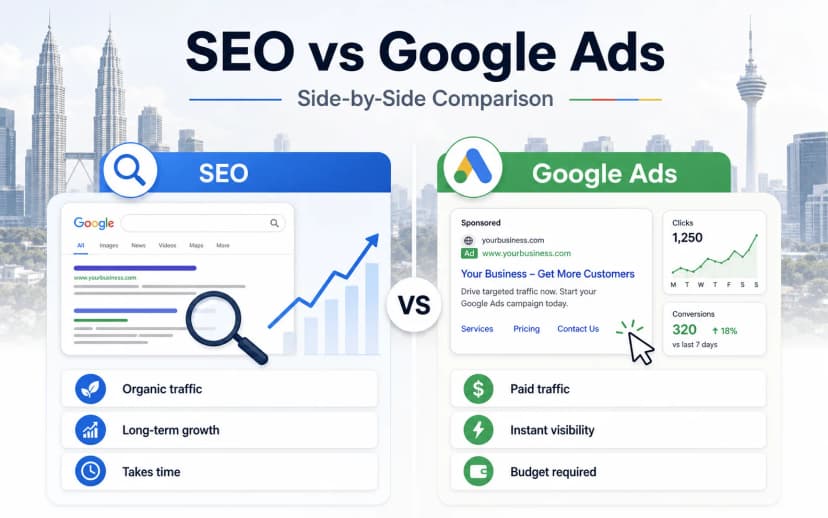
Note: All figures shown in USD with MYR conversions in brackets, based on USD 1 ≈ RM 4 (April 2026 rate).
| Factor | SEO | Google Ads |
|---|---|---|
| Time to first results | 3–6 months | 24–72 hours |
| Cost model | Monthly retainer or one-off project | Pay per click (PPC) |
| Typical Malaysian SME budget | RM 2,500–7,000/month | RM 3,000–15,000/month |
| Average CPC | N/A (organic clicks are free) | USD 2.69 / RM 10.60 (RM 1.50–RM6.00 in Malaysia) |
| Traffic sustainability | Compounds over time | Stops when you stop paying |
| Long-term ROI | High (3–5 year compounding) | Linear — pay for what you use |
| Control over placement | Limited — Search engines decide ranking | High — bid your way to position 1 |
| AI Overview impact | CTR dropped 15–46% on overview queries | Ad spend rising as advertisers compete for shrinking SERP space |
| Best for | Long-term brand and revenue compounding | Immediate leads, product launches, urgent demand |
Borrowed vs Owned Traffic
SEO traffic compounds.
Google Ads traffic disappears.
An article that ranks for "small business accounting Malaysia" can generate leads every month for years.
The work happens once (with periodic refreshes). The traffic keeps coming.
A Google Ads campaign for the same keyword stops the second your card declines.
You never own the traffic, just renting it from Google until you stop paying.
This isn't a small distinction.
According to a study conducted by Ahrefs, the average top-10 ranking page is over 2 years old, meaning SEO work done 2 years ago is still paying off today. Google Ads has zero of that compounding effect.
For businesses planning beyond the next quarter, this is the biggest single difference between the two search engine marketing.
Cost: Apples vs Oranges
Comparing SEO costs to Google Ads costs is harder than it sounds because they're priced differently.
SEO costs in Malaysia (2026):
- Basic monthly retainer: RM 1,500–3,000/month
- Standard SME retainer: RM 2,500–7,000/month
- Enterprise retainer: RM 7,000–25,000+/month
- One-off audit: RM 2,500–10,000
Google Ads costs in Malaysia (2026):
- Average CPC: RM 1.50– RM6.00, depending on the industry
- Practical monthly minimum: RM 3,000–5,000 (anything less and you don't get enough data to optimise)
- Competitive industries (legal, finance, real estate): RM 10,000–30,000+/month for serious traction
- Agency management fee: typically 15–20% of ad spend, or a fixed retainer
You should be focused on calculating cost per lead, not cost per click or cost per month.
A RM 5,000/month Google Ads campaign that generates 50 leads costs RM 100/lead.
An RM 5,000/month SEO campaign that generates 30 leads in month 6 costs RM 167/lead, but those same 30 leads keep coming in months 12, 18, and 24. By year 2, the SEO cost per lead drops to a fraction of Google Ads' cost per lead.
If you calculate your marketing investment, Google Ads is more expensive per lead over the long term, whereas SEO is more expensive per lead in months 1–6 because the work is happening before leads are generated.
Speed of Results
This is where Google Ads has structural dominance.
Set up a Google Ads campaign on Monday morning, and you can have qualified clicks by Monday afternoon.
For businesses facing cash-flow pressure, immediate sales targets, or urgent product launches, speed matters.
SEO doesn't move that fast and never will. Google needs months to crawl your content, evaluate quality, assess your backlink profile, and decide where to rank you. Only 5.7% of newly published pages reach the top 10 within a year.
If you need leads fast, Google Ads should be your ideal choice.
But you should also invest in SEO for long-term results.
We always suggest our clients have a mixture of two, depending on their budget. Once their website's SEO starts to yield results, we gradually reduce the budget invested in Google Ads.
What AI Overviews Changed (The 2026 Layer)
AIO has been the focus when we talk about search marketing in 2026.
AI Overviews changed the SEO vs Google Ads calculation.
AI Overviews now appear in roughly 25–50% of Google searches, with click-through rates dropping by 15–46% on queries where they appear.
That's a sizeable chunk of organic traffic redistributed away from blue links.
There are two important things you can learn from SEO vs Google Ads:
1. SEO is now harder, but more concentrated in value.
The clicks that do happen on organic results tend to be from users who weren't satisfied by the AI Overview and want deeper information. That makes them higher-quality clicks. Lower volume, higher intent.
2. Google Ads spend has gone up.
With AI Overviews eating organic CTR, more advertisers are bidding for the same paid slots. CPCs in competitive Malaysian industries have increased by 10–25% since 2024.
The "Google Ads is expensive" complaint is more accurate than ever.
The SEO winner in this environment isn't the agency that ranks you #1.
It's the one that gets your content cited in AI Overviews and generative engines like ChatGPT, Claude and Gemini.
AIO is the new top of the SERP.
Tracking and ROI
Both channels are measurable, but they measure different things.
Google Ads tracking: The metrics are available instantly once you start the ad campaign. The Google Ads dashboard shows you cost, clicks, conversions, ROAS, and quality score in real time. Cause and effect are clear: where you spent X, you got Y.
SEO tracking: It can get messy if you're not tracking the metrics that matter. Google Search Console shows impressions, clicks, and average position. Google Analytics 4 shows what users do on your site.
But attributing a specific lead to a specific SEO action is harder, and the impact of AI Overview isn't fully reported in GSC yet.
The metrics that matter for both channels:
- Cost per lead: total spend ÷ qualified leads
- Cost per acquisition (CPA): total spend ÷ paying customers
- Customer lifetime value (CLV): long-term revenue per customer
- Return on ad spend (ROAS): revenue ÷ ad spend (Google Ads) or content investment (SEO)
The platform with the better CLV-to-CAC ratio delivers more long-term value, even if its short-term costs appear higher.
Which One Should You Pick?
Answer these five questions.
1. How quickly do you need leads?
- This week: Google Ads
- This month: Google Ads, with SEO starting in parallel
- This quarter: SEO can produce some movement, Google Ads fills the gap while SEO compounds
- This year: SEO leads, Google Ads as needed
2. What's your budget?
- Under RM 3,000/month: Pick one. Trying to do both on this budget, neither works.
- RM 3,000–10,000/month: Lead with the channel that fits your timeline and business nature. Allocate 20–30% to test the other.
- Over RM 10,000/month: Run both. The combined visibility is worth the management overhead.
3. How long can you wait for compounding?
If you can budget for 12 months of SEO work without revenue from it, the long-term ROI is hard to beat.
If you need a positive ROI within 90 days, Google Ads is the safer bet.
4. What's your industry like?
- High-competition niches (legal, finance, real estate, aesthetics): Both. Google Ads to get visibility while SEO catches up.
- Local services (plumber, dentist, mechanic): SEO + Google Business Profile. Google Ads only if Google Business listings aren't enough.
- E-commerce: Both. Google Shopping is high-ROI; SEO captures product discovery.
- B2B SaaS: SEO heavy for content marketing, Google Ads for high-intent demo signups.
5. How patient is your team?
SEO punishes impatience. Most businesses cancel SEO at month 5 or 6, right before the work starts to compound at month 7–8. If your team can't commit to 12 months of consistent investment without panicking at month 4, Google Ads is the better choice. The traffic stops when you stop paying, but at least the math is predictable.
The Practical Answer for Most Malaysian SMEs
If you have to pick one to start, Google Ads in months 1–3, SEO from month 2 onwards. Google Ads will help you validate your theories before moving on to SEO efforts.
Google Ads usually gives you immediate market data that matters to your search marketing efforts, such as which keywords actually convert, which landing pages work, and which offer your audience responds to.
That data feeds directly into your SEO strategy.
By month 6, your SEO content starts ranking.
By month 12, organic traffic supplements paid traffic.
By month 24, SEO might be carrying 60–70% of your inbound leads, and you can start scaling
Google Ads is back to test new niches.
It may look like a theoretical approach, but this is how it works for most service-based and e-commerce businesses in Malaysia.
Start fast with paid, build slow with organic, let them feed each other.
The Combined Strategy
If your budget allows, running both channels together produces results neither can achieve alone.
- SERP dominance: Google Ads at the top, organic ranking below. You take up more screen space.
- Keyword intelligence: Google Ads conversion data tells you which keywords are worth ranking for organically.
- Risk management: If a Google algorithm update tanks your organic rankings, paid traffic keeps revenue flowing while you recover.
- Brand visibility: Repeated visibility on the same SERP builds brand recognition faster than either channel alone.
- Remarketing: SEO brings users to your site, Google Ads remarketing brings them back.
The combined strategy works best when you treat them as one system rather than two separate channels.
Same keyword research.
Same landing pages.
Same conversion goals.
Different timelines, different costs, but unified strategy.
Frequently Asked Questions
Is SEO better than Google Ads?
Neither is "better." SEO is better for long-term, compounding traffic. Google Ads is better for immediate leads and predictable scaling. Most successful search campaigns use both.
How much does SEO cost compared to Google Ads in Malaysia?
SEO retainers in Malaysia run RM 2,500–7,000/month for SMEs. Google Ads spend varies by industry — RM 3,000–5,000/month minimum for solid data, much more in competitive industries. Over the long term, SEO usually delivers a lower cost per lead because traffic compounds.
How long does SEO take to work in 2026?
3–6 months for first measurable movement, 6–12 months for serious traction. New domains and competitive industries need 12+ months. AI Overview citations can appear earlier than blue-link rankings, and that's a 2026 important change for 2026 that you need to be aware of.
Do AI Overviews kill SEO?
No, but they change it. AI Overviews reduce CTR for informational queries by 15–46%, while local, transactional, and e-commerce queries are barely affected. Local SEO and bottom-funnel SEO are still extremely valuable. The shift is toward optimising for AI citations alongside traditional rankings.
Should I use both SEO and Google Ads?
Yes, if your budget supports it. Most Malaysian SMEs with RM 8,000+/month marketing budgets see better results combining both than spending the same amount on either alone. Below that budget, focus on the channel that fits your business nature and timeline.
Is Google Ads still worth it with AI Overviews showing up?
Yes. AI Overviews eat more organic CTR than paid CTR. Google Ads slots are still highly visible above and below the overview. Some industries have seen CPCs rise by 10–25% since 2024 as more advertisers compete for the shrinking SERP space.
What's better for new businesses — SEO or Google Ads?
Google Ads first, SEO second. New businesses lack domain authority, content history, or backlink profiles, so SEO takes 9–12+ months to deliver results. Google Ads gives you immediate revenue while SEO builds in the background.
Can I do SEO without paying for an agency?
Yes, if you have the time, skill, and patience. DIY SEO works for solo operators with technical confidence. For most Malaysian SMEs, the opportunity cost of doing SEO yourself is higher than paying an agency RM 2,500–5,000/month to do it properly. Imagine hiring an SEO specialist at RM4,000+.
Final Thoughts
Stop framing this as a battle.
SEO and Google Ads aren't enemies.
They're different tools that work best together.
If you have to pick one, choose the one that best matches your business nature, budget, and timeline.
Need leads this month? Google Ads.
Building a business for the next 5 years? SEO.
Have the budget for both? Run them as a single strategy with shared keywords and goals.
The biggest mistake businesses make in 2026 is treating SEO like a 2018 game.
Ranking #1 means less than it used to.
AI search citations matter more.
Local SEO is largely untouched by AI disruption.
Pick the strategy that fits where search is going, not where it was.