TL;DR: SEO takes 3 to 6 months to show measurable movement and 6 to 12 months for strong results. New domains usually need 6–12 months because of Google's trust-building period. Established sites with existing authority can see targeted wins in 4–8 weeks.
Local SEO moves fastest and sometimes within weeks.
2026 focuses on AI Overview and AI search citations can appear before traditional blue-link rankings, which changes how progress looks. Only 5.7% of newly published pages reach the top 10 within a year, so patience isn't optional.
Every business owner asks the same question after starting an SEO campaign.
"When am I going to see results?"
The boring answer is "it depends."
Do you want the real data-backed answers? Keep reading.
This article breaks down the 2026 SEO timeline for Malaysian businesses by month, by site type, and by industry competition.
No magic numbers. No false promises.
How Long Does SEO Take to Produce Results?
The short answer: 3–6 months to see positive movements, 6–12 months for serious traction.
The longer version is more nuanced.
Three timelines you can consider.
- Established site, low-to-medium competition: 4–8 weeks for targeted ranking improvements on specific pages
- New site, normal competition: 6–12 months before serious traction kicks in
- New site, competitive industry (finance, legal, aesthetics, real estate): 12 months or more
Anyone promising page-1 rankings in 30 days?
Anyone telling you to wait 18 months before measuring anything isn't tracking the right signals?
Stay away from them.
Always remember that SEO is a long-term commitment, but you can see positive growth once you start implementing strategies and producing valuable content.
You need to be realistic and focus on the long-term growth for SEO.
SEO rewards consistency over time, not bursts of effort.
What's Different in 2026
The basic timeline hasn't changed much since 2020.
But these three things are something crucial for you to understand for 2026.
AI Overviews are a faster signal than rankings.
A new piece of well-structured content can get cited in Google AI Overviews or ChatGPT within weeks.
Sometimes, it ranks #1 on traditional SERPs.
If your content gets cited but isn't ranking yet, that's a positive sign, not a failure.
Google's trust period is stricter
The March 2026 spam updates targeted scaled and thin content directly.
New sites that publish 50 generic articles in their first month aren't accelerating their timeline; they're risking algorithmic suppression.
Slow and substantive beats fast and shallow in 2026.
Local SEO moves faster than ever.r
Google Business Profile work, citations, and reviews can produce ranking movement within 2–4 weeks for local Malaysian businesses. Local SEO is the fastest-moving SEO discipline in 2026 — and AI Overviews trigger on only 7% of local searches, so AI search hasn't disrupted local results much.
Factors That Decide Your Timeline

These are the top eight factors that influence your SEO timeline. And remember that you are not in control of every factor.
Make sure to focus on the factors that can make a difference for your SEO campaigns.
1. Domain Age and Authority
Older domains rank faster.
Not because of age itself, but because they've accumulated backlinks, content, brand mentions, and Google's trust signals over time.
A 5-year-old domain with 200 referring domains will see SEO results within weeks. A new domain with zero backlinks faces what SEOs call the "Google Sandbox", a period of 6–12 months where rankings are suppressed regardless of content quality.
Google doesn't officially confirm the sandbox, but every SEO who's launched a new site has experienced it.
If you're starting fresh, plan for the long runway.
Don't get discouraged during months 1–4 when nothing seems to be moving.
2. Industry Competition
The competition in your industry is the biggest single factor.
- Low competition (artisan products, hyperlocal services in smaller Malaysian cities, niche B2B): 2–4 months to results
- Medium competition (most local services, professional services, F&B chains): 4–8 months
- High competition (finance, insurance, real estate, aesthetics, legal, e-commerce): 6–12 months minimum
Ranking for "artisan soap Klang" is fast.
Ranking for "personal loan Malaysia" is a multi-year project.
3. Technical Site Health
A site with technical issues slows everything down.
These are some of the common overlooked technical issues:
- Core Web Vitals failures (LCP over 2.5 seconds, INP over 200ms, CLS over 0.1)
- Mobile rendering issues
- Crawl errors and broken internal links
- Missing or malformed schema markup
- Indexation problems
- Cheap shared hosting is causing slow server response times
Sites with major technical issues need 1–2 extra months of cleanup before SEO work moves rankings. Clean sites get to the optimisation phase faster.
4. Backlink Profile
Backlinks still matter, especially in competitive niches. A site with no external backlinks takes longer to rank for competitive terms because it hasn't established authority beyond its own pages.
The 2026 link-building reality: digital PR, original research, real partnerships, and quality guest posts work. PBNs, mass directories, and Fiverr links don't — and the March 2026 spam update specifically targets them.
Cheap link building is simply risky today.
5. Content Quality and Consistency
A site publishing two strong articles per month outranks a site publishing fifty thin ones in a sprint and going quiet.
Google rewards consistency and depth, not volume.
The 2026 baseline for content quality includes original data or first-hand experience, a named author with real credentials, an answer-first structure, schema markup, internal links, and a proper editorial review before publication. AI-written generic content doesn't pass this bar.
6. Search Intent Match
Content that directly matches search intent moves faster than content that technically contains the right keywords.
A page targeting "how to file SST in Malaysia" needs to actually answer that question in the first 100 words, not bury the answer 800 words deep behind a generic intro.
7. On-Page SEO
This is where you can move fastest.
Title tags, meta descriptions, heading structure, internal links, image alt text, and primary keyword placement can all be optimised in days.
Movement on these often shows up within 2–4 weeks.
Don't underestimate the on-page optimisation. It's the highest-leverage work in the early months of any SEO campaign.
8. Budget and Resourcing
Bigger budgets buy more content, more outreach, faster technical fixes, and access to better tools.
Sadly, they don't readily earn Google's trust.
But they shorten every other phase of the timeline.
RM3,000/month, done well, will outperform RM8,000/month, done badly.
But within the same quality tier, more budget means faster results.
Month-by-Month SEO Timeline (2026)

Here's what a result-driven SEO campaign looks like, month by month, for a Malaysian business with an established site in a medium-competition industry.
Month 1: Foundation
Most of the work happens behind the scenes. No visibility in search rankings and traffic.
- Full technical SEO audit
- Keyword research and intent mapping
- Competitor analysis (organic + AI citation)
- Content gap analysis
- Google Search Console and Analytics 4 setup
- Initial on-page fixes on existing high-value pages
- Schema markup implementation
If your site has serious technical issues, fixes start now.
For larger sites, audit work can stretch into month 2.
Month 2: Implementation
Technical work continues. Content creation starts with the right schedule, where consistency matters.
- Core Web Vitals fixes
- Internal linking architecture cleanup
- Title and meta description optimisation across all priority pages
- First batch of new content published (2–4 articles)
- Initial backlink outreach starts
You'll see Search Console impressions tick up by the end of this month.
Rankings are still unstable.
Month 3: Early Traction
This is when the first signs of progress appear.
- Long-tail keywords start ranking on the 2nd to 4th pages
- Some on-page optimised pages climb around 5 to 15 positions
- Content from month 2 gets indexed and starts accumulating impressions
- Backlink outreach yields first earned links
- AI Overview citations may start appearing for well-structured content
Traffic is still modest.
Don't measure final results yet.
You must measure the positive impact your SEO campaign is generating.
Month 4: Acceleration Phase
Compounding starts kicking in.
- Earlier content moves from page 3 to page 1 for less competitive terms
- Topical authority starts building — new content ranks faster than the month 1 content did
- Search Console clicks are visibly trending up
- First conversions from organic search
- Branded search volume starts increasing slightly
Month 5: Momentum
Real traffic growth.
- Several target keywords on page 1
- Organic traffic is improving over time
- Lead flow from organic becomes consistent
- Content promotion through social and email amplifies results
- Conversion rate optimisation starts on pages with high traffic
Month 6: Inflexion
The "is this working?" question now has a clear answer.
- Organic traffic 2–3x the starting baseline for most niches
- Multiple priority keywords ranking on page 1
- SEO is becoming a real share of total leads
- Strategic review and determine what's working, what isn't, next 6-month plan
Month 7–12: Compounding
SEO turns into a flywheel.
- New content ranks within 2-4 weeks, instead of 8-12 weeks
- Domain authority growth makes everything faster
- Organic traffic 200–500% above starting baseline (in normal niches)
- Cost per lead from organic drops significantly
- SEO becomes one of your strongest revenue channels
Beyond 12 Months
The compounding doesn't stop.
Articles published in month 2 are still generating leads in year 3.
New content lifts off faster. Brand visibility in AI search expands.
Once SEO momentum builds, it pays for itself many times over.
Why Some Businesses Fail at SEO

The pattern is the same every time.
A business hires a service provider to execute its SEO campaign.
They expect leads in month 2.
Month 3 comes and goes with modest movement.
Month 4 looks better, but it's still not enough to justify the spend.
They cancelled the service provider in month 5.
Then they switch to a new agency, restart the timeline, and hit month 5 again.
They cancelled again.
SEO doesn't fail because the work was wrong. I
t fails because the patience ran out before the compounding started. The businesses that win at SEO are the ones that commit to at least 12 months and treat the first 6 months as foundational work.
If you can't budget for 6–12 months, paid ads or social ads will get you to leads faster.
Don't start SEO with the wrong expectations and waste both your money and the agency's effort.
How to Speed Up Your SEO Results
You can't break the trust-building period Google enforces.
You can shorten everything else around it.
- Start with low-competition long-tail keywords. Get early wins to build momentum and confidence.
- Update existing high-traffic pages rather than focusing on publishing new content. The existing pages already have indexing signals.
- Fix technical issues quickly to ensure your site is fully ready for search engines to crawl and index your pages.
- Build topical clusters, not random pages. Google rewards in-depth coverage of topics.
- Earn backlinks through original research. One piece of cited research outperforms ten guest posts.
- Optimise for AI Overview citations: In 2026, you should start focusing on answer-first format, schema, named authors, and original data.
- Maintain consistent publishing. Avoid publishing 10 to 20 articles in one go. 2–4 quality articles per month beats inconsistent bursts.
Frequently Asked Questions
How long does SEO take to work in Malaysia?
Most Malaysian businesses see measurable SEO results in 3–6 months and strong results in 6–12 months. New domains and competitive industries take longer, often 12+ months, to gain significant traction.
Why does SEO take so long?
Search engines like Google need time to crawl your site, evaluate content quality, assess your backlink profile, and compare you against every competitor targeting the same keywords. The system is designed to resist manipulation, so new sites must demonstrate consistency over time before earning trust signals.
Can SEO work in 30 days?
Only for very low-competition keywords or technical optimisation on established sites. For competitive keywords, 30 days is nowhere near enough. Anyone promising page-1 rankings in 30 days is either targeting keywords nobody searches for or using black-hat tactics that will hurt you in the long term.
How fast does local SEO work in Malaysia?
Local SEO is the fastest-moving SEO discipline. Google Business Profile optimisation, citations, and reviews can drive ranking changes within 2–4 weeks for low- to medium-competition local searches. AI Overviews trigger only 7% of local searches, so the AI search disruption hasn't slowed local SEO.
Does SEO work faster for old domains?
Yes. Established domains with existing backlinks, content, and Google trust can see results from targeted SEO work in 4–8 weeks. New domains face a 6–12-month "sandbox" period during which rankings are suppressed regardless of content quality.
How long should I commit to SEO?
Minimum 6 months. Ideally 12. SEO results compound over time. The work in months 1–6 produces results in months 7–12, and the work in year 1 produces compounding gains in years 2 and 3. Discontinuing SEO implementation at month 4 wastes the investment because the payoff window hasn't started yet.
How do I know if SEO is working before rankings move?
There are five early indicators. Rising Search Console impressions, indexation of new content, ranking movement on page 2–4 (before reaching page 1), AI Overview or ChatGPT citations of your content, and growing branded search volume. These show up before final rankings and before traffic spikes.
What's the difference between SEO and Google Ads timelines?
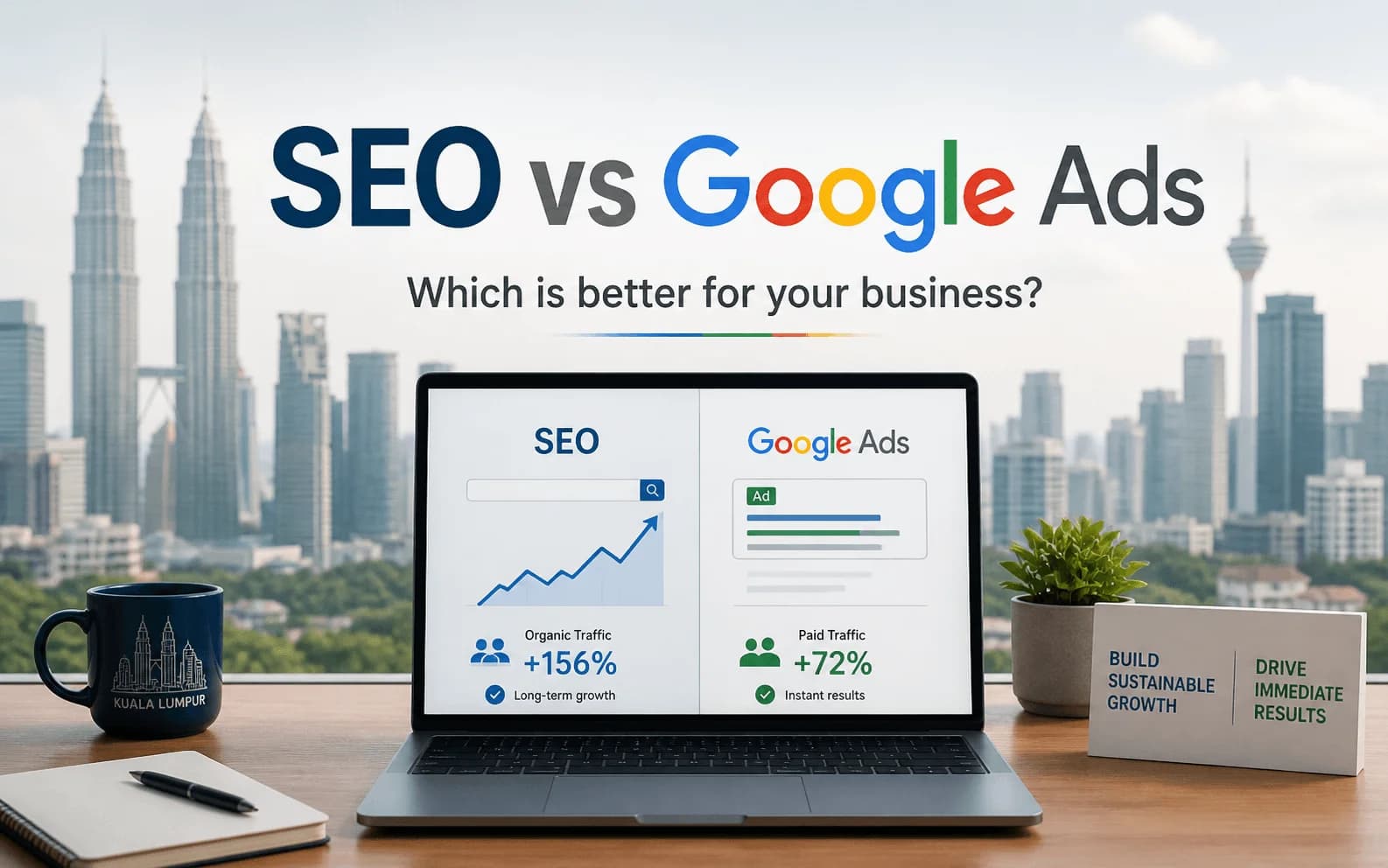
Google Ads delivers traffic on day one but stops the moment you stop paying. SEO takes 3–12 months to deliver, but keeps generating traffic for years after the work is done. Most Malaysian businesses do best by combining both: Paid Ads provide immediate leads, while SEO builds long-term momentum.
Final Thoughts
SEO isn't slow.
Google is cautious.
There's a difference.
The trust-building period that frustrates new sites is the same period that protects your visibility once you've earned it.
If SEO worked overnight, every spam site and AI content farm would dominate the SERPs, and your business wouldn't have a chance.
The simple answer: Budget for 12 months, treat months 1–6 as foundation work, expect month 6 to feel like a turning point, and let the compounding do its job from there.
One question to ask yourself: "Am I evaluating my SEO at the right milestone, or am I checking month 3 and expecting month 12 results?"
Most businesses fail SEO because they cancel before the work pays off, and not because the work was wrong.