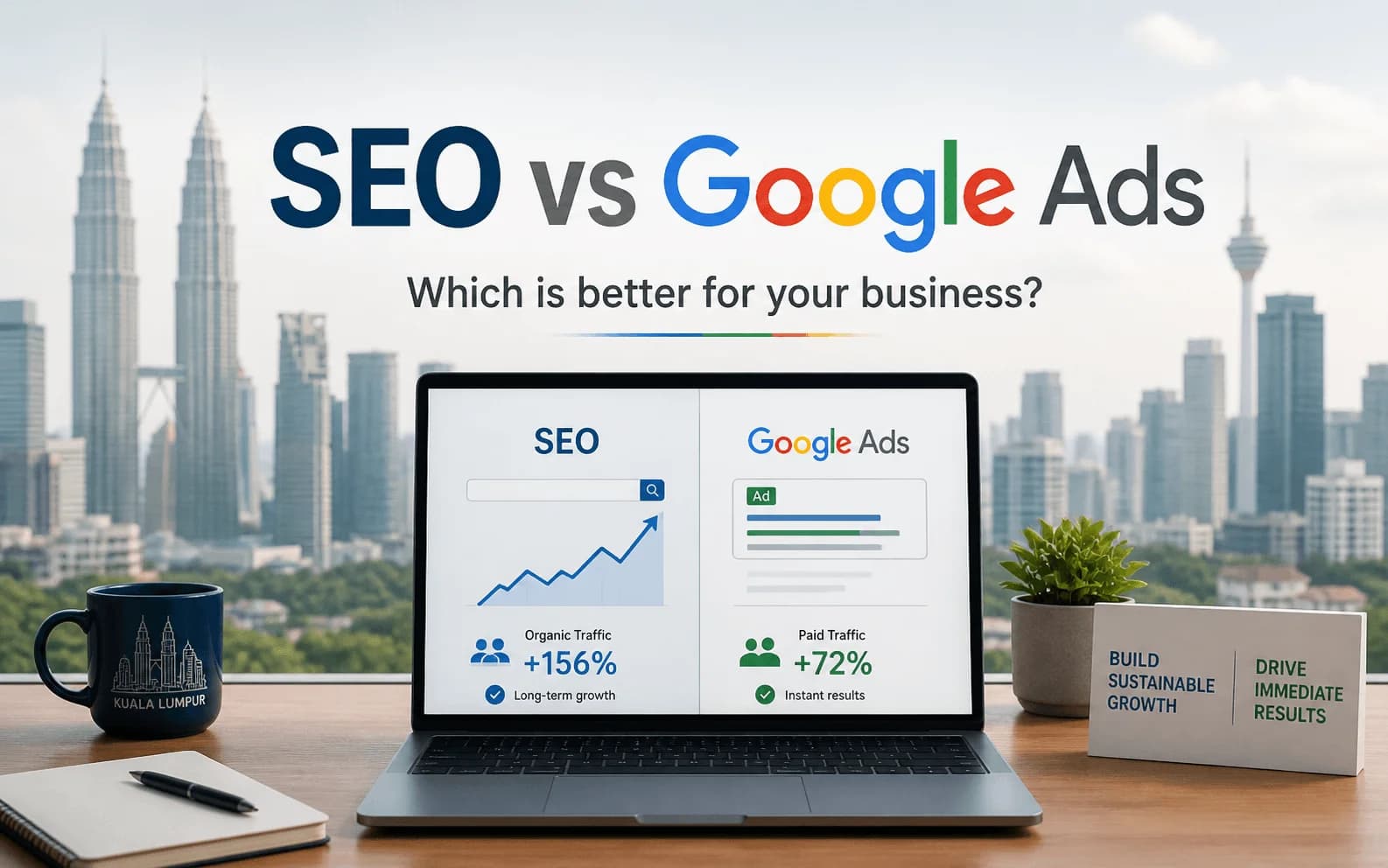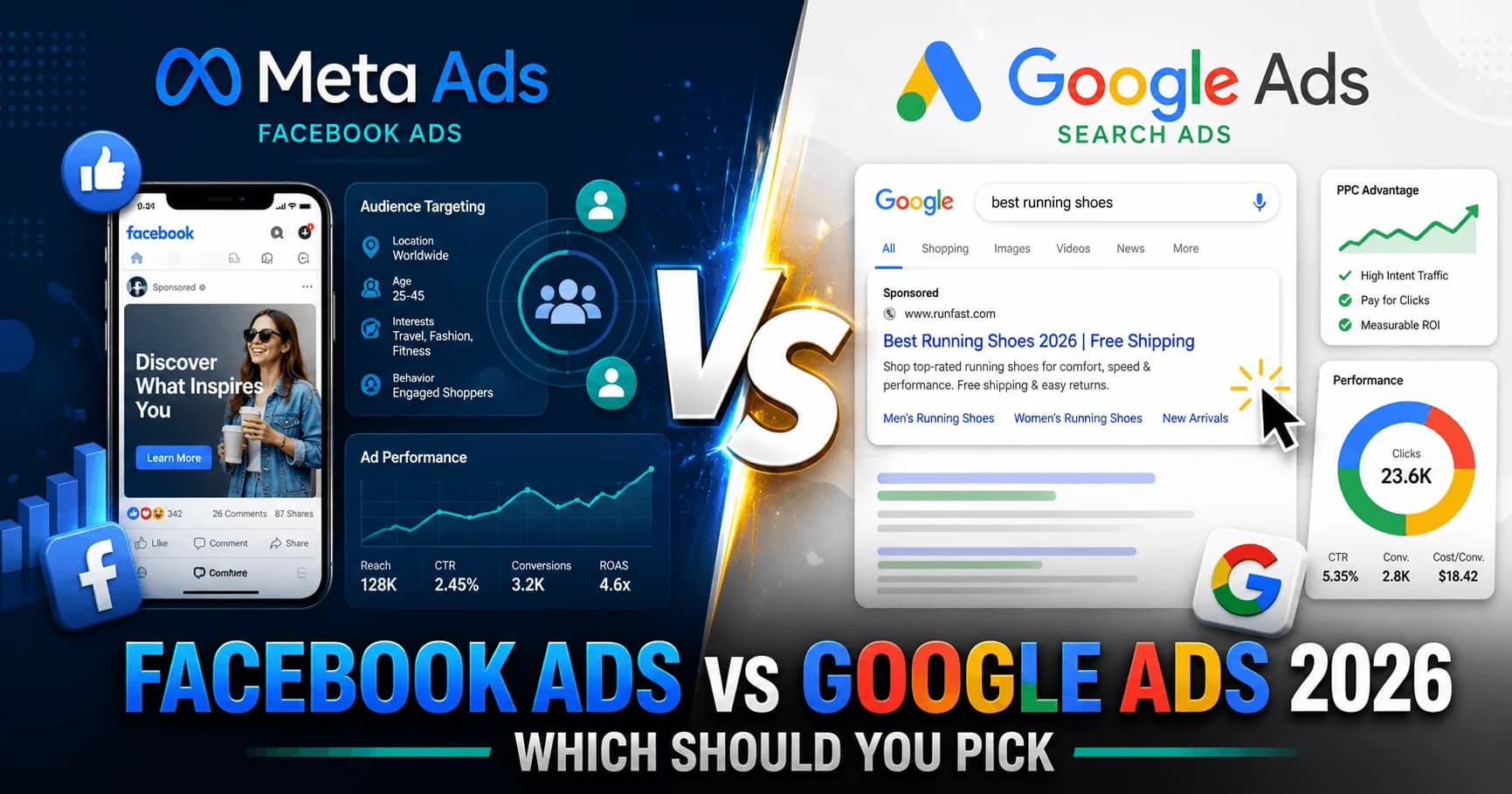
TL;DR: Google Ads attract buyers who already want what you sell. Facebook Ads creates demand by putting your brand in front of people who didn't know they wanted it yet.
Google Ads averages USD 2.69 (~RM 10.60) CPC but converts at around 4.4%. Facebook Ads averages USD 0.62–1.07 (~RM 2.45–4.25) CPC but converts at about 1.85%.
If your sales cycle is short and people search for what you offer, start with Google Ads.
If you sell a visual product, a new category, or a B2C lifestyle brand, start with Facebook Ads.
With a budget under RM 3,000/month, pick one and do it well — don't split.
Different agencies have different approaches towards Facebook Ads versus Google Ads.
One says Facebook is dead, and you should put everything into Google.
Another says Google is too expensive for SMEs, and Facebook is the answer.
The third says you should run both simultaneously.
The ideal scenario is more boring than any of these.
Each platform serves a different job.
The right choice depends on your business nature, sales cycle, and budget. It was never about which platform is better. What works for others might not work for you, even if you're from the same industry.
This article breaks down what each platform actually does in 2026, what it costs, and how to decide which one fits your business.
The Core Difference
Google Ads is for capturing existing demand.
Someone searching "laser hair removal in Klang" is actually looking for the right laser hair removal aesthetic clinic. You just need to appear in front of them on the search result pages or any relevant platforms and persuade them to click your link.
Facebook Ads are for creating demand.
Someone scrolls Instagram, sees your skincare brand, and thinks, "I'd never heard of this, but it looks good."
They didn't wake up looking for your product.
You introduced it.
That single distinction shapes every other decision, from cost, targeting, creative, sales cycle, and even the type of business each platform fits.
What Are Facebook Ads (Meta)?
Facebook Ads (now branded under Meta) runs across four properties: Facebook, Instagram, Messenger, and Audience Network (third-party apps).
All four share one ad management system controlled through Meta Ads Manager.
The platform's core strength is granular audience targeting.
Meta has years of behavioural and interest data on its users, including what they like, what they share, where they shop, and what they search for elsewhere.
Advertisers use those behaviours to target their ideal audiences at a level no other platform can match.
One important shift in 2026 to take note of.
Apple's privacy changes have fully matured, and Meta's Advantage+ AI tools now carry most of the targeting weight.
Broad targeting with strong creative consistently outperforms narrow, interest-stacked audiences.
The old playbook of "stack 10 interests and exclude lookalikes" is no longer the right move.
What Are Google Ads?
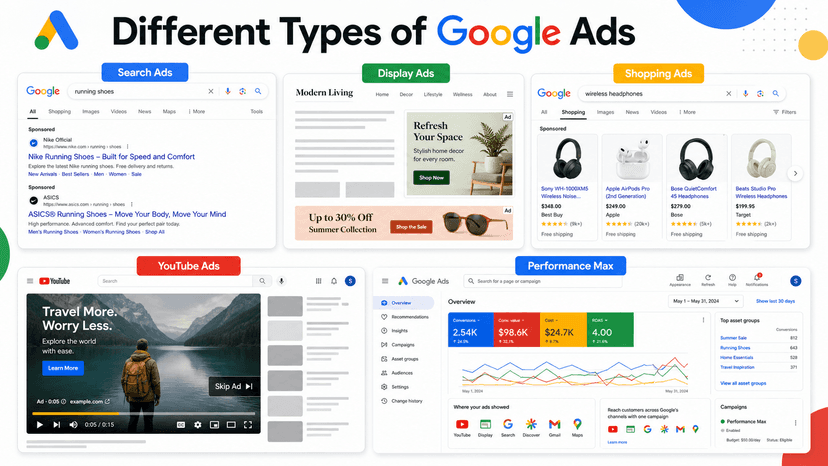
Google Ads runs across Search, YouTube, Gmail, Display Network (millions of partner sites), and Maps.
Search is the headline product where text ads appear at the top of search results, triggered by the keywords or search queries someone types.
The pricing model is auction-based.
You bid for keywords, pay when someone clicks (Pay-Per-Click), and your ad's position depends on a combination of bid amount and Quality Score (how relevant your ad and landing page are to the search).
So what's different in 2026?
Performance Max campaigns now run across all Google placements simultaneously: Search, Display, YouTube, Gmail, and Maps. They use machine learning to optimise bidding, targeting, and creative.
Performance Max has gone from optional to default for most accounts. Smart Bidding (Target CPA, Target ROAS, Maximise Conversions) is the standard bidding approach today.
Facebook Ads vs Google Ads: The Real Numbers for 2026
The cost gap between the two platforms is significant.
The conversion gap closes some of it.
Note: All figures shown in USD with MYR conversions in brackets, based on USD 1 ≈ RM 4 (April 2026 rate). Global benchmarks. Malaysian costs typically run lower — see the section below.
| Metric | Facebook Ads | Google Ads |
|---|---|---|
| Average CPC | USD 0.62–1.07 (RM 2.45–4.25) | USD 2.69 (RM 10.60) |
| Average conversion rate | ~1.85% | ~4.40% |
| Buyer intent | Discovery / casual | Active purchase intent |
| Sales cycle fit | Long, awareness-driven | Short, problem-driven |
| Targeting style | Interest, behaviour, lookalike | Keyword + intent signals |
| Time to first conversion | 7–14 days (learning phase) | 24–72 hours |
| Best for | B2C, visual products, new brands | B2B, services, high-intent buyers |
| Minimum daily budget | USD 5/day (RM 20/day) per campaign | USD 10–20/day (RM 40–80/day) for solid data |
Sources: WordStream Industry Benchmarks 2025-2026, Meta Business Help Centre, AdsGo cross-platform campaign data
For Malaysian advertisers, costs run lower than US benchmarks across both platforms.
Typical Malaysian advertising costs range:
- Google Ads CPC in Malaysia: RM 1.50–6.00 (depending on industry; legal and finance higher, e-commerce lower)
- Facebook Ads CPC in Malaysia: RM 0.30–2.00 (B2C niches typically RM 0.50–1.00)
- Practical monthly starting budget: RM 1,500–3,000 per platform for a campaign with enough data to optimise
Audience Size and Reach
Both platforms have a massive reach.
Audience size isn't the deciding factor.
It's all about context!
Google processes around 8.5 billion searches per day globally.
The reach is enormous, but it's only useful if people are actively searching for what you sell. If you're launching a brand-new product nobody knows about, Google can't help you, as there's no search volume for something nobody knows exists.
Meta has roughly 2 billion daily active users across Facebook and Instagram.
The reach is broad, and the platform is exceptional at putting your brand in front of audiences who haven't heard of you.
That's exactly where Google Ads fails.
Two questions decide which audience matters more to you:
- Are people already searching for what I sell? If yes → Google Ads. If no → Facebook Ads (or both).
- Is my product visual or experiential? If yes → Facebook/Instagram leans heavily. If no → Google works fine on its own.
Cost and ROI
This is where the comparison gets interesting.
Lower CPC doesn't mean cheaper customers.
Facebook's CPC of USD 0.62 (RM 2.45) looks irresistible next to Google's USD 2.69 (RM 10.60). But Google's higher CPC is offset by 2–3x stronger conversion rates because the user already wants what you're selling.
The actual metric that matters is cost per acquisition (CPA), not CPC.
For a search-driven business like a plumber, a dentist, a B2B SaaS company, or a tax consultant, Google Ads almost always wins on CPA despite higher ad costs.
For a discovery-driven business, like a fashion brand, an F&B chain, a fitness studio, or a beauty product, Facebook Ads usually win on CPA because lower click costs, combined with retargeting, bring customers back at a lower total acquisition cost.
One 2026-specific shift worth remembering.
Facebook lead-generation campaigns have weakened. The cost per lead jumped 21% year over year while conversion rates dropped from 8.67% to 7.72%.
Traffic campaigns improved with CPC dropping 6.7% to USD 0.70 (RM 2.80).
So what does it mean?
Facebook still wins on cheap traffic and brand awareness, but it's no longer easy to generate leads as you did in 2022.
Buyer Intent
This is where Google has structural dominance.
Someone searching for "emergency plumber Subang" has a problem right now.
They want a solution in the next 30 minutes.
They click the first ad that looks credible.
Compare that to Facebook.
The same person scrolling Instagram on the toilet doesn't want to think about plumbing. Even if your plumbing ad shows up, it doesn't convert.
Wrong context, wrong moment.
For services people search for in moments of need (legal, medical, repair, urgent, B2B comparison), Google is structurally better. For products people discover when relaxed (fashion, food, lifestyle, gifts, hobbies), Facebook is structurally better.
This isn't a debate about "which platform is better."
It's about matching the right platform for the right buyer intent.
Targeting
Facebook still wins on granular targeting, despite Apple's privacy changes reducing some signals.
Meta's targeting is built on:
- Demographics (age, gender, location, language)
- Interests (pages liked, content engaged with)
- Behaviours (purchase patterns, device usage, travel)
- Lookalike audiences (find users similar to your existing customers)
- Custom audiences (retargeting site visitors, engagers, customer lists)
You can target "small business owners in Klang Valley interested in digital marketing who recently engaged with B2B content". That level of precision doesn't exist on Google Ads.
Google's targeting is fundamentally different.
Instead of building audience profiles, you target intent signals through keywords.
Someone typing "best CRM for SMEs" shows intent regardless of their demographics. Google supplements this with audience layers (in-market segments, affinity audiences, custom intent), but keywords and phrases remain the core lever.
For businesses with a clearly defined niche audience, Facebook's interest and behaviour targeting is unmatched.
For businesses where intent matters more than identity, Google Ads works better.
Ad Formats
Facebook is visual-first.
The platform rewards strong creatives with images, video, reels, carousels, and stories.
A B2C brand with great visuals will outperform on Facebook even with a smaller budget.
Common Meta ad formats in 2026:
- Feed ads (Facebook and Instagram)
- Reels ads (highest CPM discount, around 30–40% cheaper than feed)
- Stories ads
- Carousel ads
- Collection ads (for e-commerce catalogue showcase)
- Lead Ads (in-platform forms)
- Messenger and WhatsApp click-to-chat ads
Google's ad formats are more varied because of the network spread:
- Search ads (text on search results)
- Shopping ads (e-commerce product listings)
- Display ads (image/video across partner sites)
- YouTube ads (skippable, non-skippable, bumpers, in-feed)
- Performance Max (automated across all placements)
- Demand Gen (Discover, Gmail, YouTube)
- App campaigns
For Malaysian e-commerce businesses, Google Shopping is often the highest-ROI format on either platform.
Direct product listings tied to search intent, with clear pricing and ratings shown upfront.
Which One Should You Choose?
Answer these five questions, and you will find out which ad platform works well for your business.
1. What's your business model?
- B2B services (legal, accounting, IT, consulting): Start with Google Ads. People search for solutions when they have a specific need.
- B2C visual products (fashion, beauty, lifestyle, F&B): Start with Facebook/Instagram Ads. Discovery beats search.
- Local services (plumber, dentist, mechanic, tutor): Google Ads using local-intent keywords. Map placement is gold.
- E-commerce: Both. Google Shopping for direct intent, Facebook for retargeting and discovery.
- SaaS: Google Ads for bottom-funnel intent, plus Facebook for content amplification and retargeting.
2. What's your sales cycle?
- Short (impulse buy, urgent need): Google Ads delivers conversions in 24–72 hours.
- Long (considered purchase, B2B, multi-touch): Facebook nurtures awareness over weeks, Google closes at the bottom.
3. How much budget do you have?
- Under RM3,000/month: Pick one platform and master it. Splitting too thin kills both campaigns.
- RM3,000–10,000/month: Lead with the platform that fits your business model, allocate 20–30% to test the other.
- Over RM10,000/month: Run both. Use proper attribution to measure blended ROI.
4. Do you have visual creative resources?
Facebook eats creative for breakfast.
If you don't have strong visuals, video-editing capacity, or a willingness to outsource them, Google Ads is more forgiving, as text ads and Shopping feeds don't need cinematic creative.
5. What's your team's skill?
Both platforms now have steep learning curves.
Google requires keyword research, Quality Score management, and an understanding of bid strategy.
Facebook requires creative testing, audience iteration, and patience during Meta's 7–14-day learning phase.
If you're DIY-ing this, start with one platform until you've got a profitable campaign running.
Don't try to learn both at once.
The Practical Answer for Most Malaysian SMEs
If you're a Malaysian SME asking which platform to start with, here's your answer.
If your customers search for what you offer (services, B2B, problem-solving products), start with Google Ads. The intent advantage usually outweighs the higher CPC.
If your customers discover what you offer (visual products, lifestyle brands, food, fashion), start with Facebook Ads. Lower entry cost, faster experimentation, and the platform fits the buyer's mindset.
Once one platform is profitable, experiment with the other.
Most successful campaigns in 2026 will be the combination of both search and social ad platforms.
Facebook for awareness and retargeting, Google for capturing high-intent traffic when buyers are ready to act.
Tracking Your Paid Ads Performance
Whichever platform you start with, track these metrics monthly:
- Cost per click (CPC) — what you pay for traffic
- Click-through rate (CTR) — relevance signal
- Conversion rate — how well your traffic converts
- Cost per acquisition (CPA) — the metric that matters
- Return on ad spend (ROAS) — total revenue ÷ ad spend
- Customer lifetime value (CLV) — long-term value, not just first sale
The platform with the higher CLV-to-CAC ratio delivers more value, even if its CPC is higher.
Use Looker Studio (formerly Google Data Studio) to pull data from both platforms into one dashboard. Cross-platform measurement is non-negotiable when you're running both.
Frequently Asked Questions
Which is cheaper — Facebook Ads or Google Ads?
Facebook Ads has a lower average CPC at USD 0.62–1.07 (RM 2.45–4.25) compared to Google Ads at USD 2.69 (RM 10.60).
However, Google Ads usually has a lower cost per acquisition because search traffic converts at 4.40%, compared with Facebook's 1.85%. The actual cheaper platform depends on your conversion rate and average order value — compare CPA, not CPC.
Which platform is better for small businesses in Malaysia?
For Malaysian B2C businesses with visual products (food, fashion, beauty, lifestyle), Facebook Ads is more cost-effective and faster to test.
For service businesses (plumber, dentist, accountant, lawyer, B2B SaaS), Google Ads converts faster and at a lower CPA.
Can I run Facebook Ads and Google Ads together?
Yes, but with a minimum total budget of around RM3,000/month. Below that, focus on one platform and master it. When you split, allocate 60% to the platform that fits your business model and 40% to the other for testing.
How quickly do Facebook Ads work?
Meta's algorithm needs 7–14 days to exit the learning phase, followed by another 1–2 weeks to accumulate sufficient data for a proper ROAS assessment. Plan for a minimum of 30 days before judging campaign performance.
How quickly do Google Ads work?
Google Search Ads can generate conversions within 24–72 hours because users have immediate purchase intent. Performance Max campaigns need 4–6 weeks of learning before delivering optimal results.
Are Facebook Ads still effective in 2026?
Yes, but the playbook has shifted. Traffic and awareness campaigns have improved (CPC down 6.7%, CTR up). Lead-generation campaigns have weakened (CPL up 21%, conversion rates falling). Facebook still wins on cost-effective reach and discovery, but it's no longer the easy lead-gen platform it was in 2022.
What is Meta Advantage+, and should I use it?
Advantage+ is Meta's AI-driven campaign management suite. It uses machine learning to identify your best audience and automatically optimise creative combinations. Advantage+ campaigns deliver 15–25% lower CPAs than manual setups in most cases.
The catch: AI needs human guidance to set clear conversion events, monitor regularly, and not trust it blindly.
What is Google Performance Max, and is it worth it?
Performance Max is Google's flagship AI campaign type that runs across Search, Display, YouTube, Gmail, and Maps simultaneously. It's powerful for accounts with strong conversion data, but it's a black box with limited visibility into what's working.
Best used alongside dedicated Search campaigns rather than as a complete replacement.
Final Thoughts
Stop asking which platform is "better."
Start asking which platform fits your business.
Google Ads catches buyers.
Facebook Ads creates them.
Both are valuable, but they solve different problems, and starting with the wrong one wastes the budget you can't get back.
Not sure which one fits your business, the simple test is to type your product or service into Google.
If you see ads competing for that exact search, your customers are already there. If nothing comes up, you're better off creating demand with Facebook before trying to capture it with Google.